
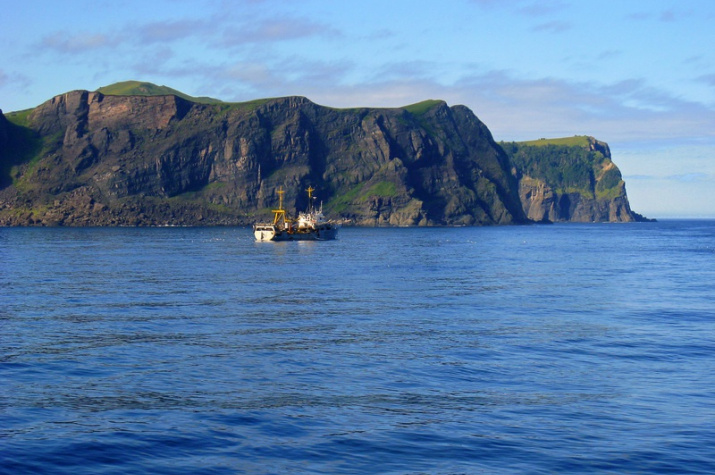
A scientific vessel with a crew of specialists from learned institutions of the Russian Academy of Sciences, Roshydromet, Rospotrebnadzor will be sent to the region of the Japanese Sea and north-western part of the Pacific Ocean. They are to assess the negative impact of the catastrophe on the habitat of human beings, animal world, eco-system of the ocean.
Location: Vladivostok
Date: 22 April, 2012
Stages:
1st stage – a 25-day expedition in terms of the 87th voyage of the scientific vessel ‘Pavel Gordienko’.
2nd stage – three-four months after the first stage.
Goals:
- Definition of potential hazards for the Far Eastern territories of Russia among which can be named emissions of radioactive substances from the nuclear power station into the air and water.
- Conduct of standard hydrometeorological observations according to the programme of a ship station, probe sampling of sea water for the detection of radionuclides and selection of air disposition samples.
- Observations of anomalies in the atmosphere, pollution of the sea water surface with oil and oil products.
- Contractor: State Institution ‘Far Eastern Regional Hydrometeorological Research Institute (FERHRI)’.
- Project participants: A. Chilingarov, special representative of the President of the Russian Federation for international cooperation in the Arctic and Antarctic, the first Vice-President of Russian Geographical Society.
Results:
- In the course of the expedition the scientists discovered in the waters of the Pacific in three points of the Kuril Ridge caesium isotopes left after the collapse of the nuclear power station ‘Fukushima – 1’. The quantity of caesium-137 amounted to about 4 becquerels per cubic meter (Bq/m3) in the waters near the Urup Island, whereas the quantity of caesium-137 there made up 3 Bq/m3 . On the contrary, the waters not far from Krusenstern Strait contained about 3 Bq/m3 of caesium-137 and about 2 Bq/m3 of caesium-134.
- This quantity of isotopes has been stated to comply with the norm and pose no hazard to people or nature.
- The air samples of the Kurils showed no iodine or caesium isotopes from Japan.